Showing posts with label tips. Show all posts

Wednesday, February 1, 2023

ProteoCool Pills #23: Selection of the right post-coloumn filter is essential to detect protein/antibody aggregates in static light scattering

Static light scattering (SLS) is a technique to measure absolute molecular weight using the relationship between the intensity of light scattered by a molecule and its molecular weight and size. 

Some SLS technologies exist: multiangle light scattering (MALS), right-angle light scattering (RALS), low-angle light scattering (LALS) and RALS/LALS hybrid systems 

MALS or RALS/LALS when coupled with other detectors (eg UV-vis, RI, densitometry, fluorimeter) in an advanced GPC-SEC system can be applied to investigate solution properties, stability testing and process development for different kind of  conjugated and unconjugateed biologics

Light scattering detectors (low-angle LALS, right-angle RALS, or multi-angle MALS) are very sensitive to the presence of particulates, when those are used for molecular weight detection in chromatography. Unfortuantelly even the best  columns can shed some particulates from their packing material. Although undetected by most conventional detectors, such as UV and RI, these particles scatter significant amounts of light, produce noise that affect the light scattering signals and baselines. To mitigate this, the MALS, LALS/RALS sistems include an in-line coloumn filter that can significantly improve the quality and thus the accuracy of both the data and results.

In this post i would like to share with you some data acquired loading different mabs in a Cytiva Supedex200 increase 10/30 coloumn in the OMNISEC instrument equiped wih the LALS/RALS detector in the presence/absence of post coloumn filter. 

First of all we compared the baseline signals that can be obtained 

- Without filter;

- With a 0,2um nylon filter;

- With 0,2um cellulose filter; 


The baseline signals suggest that nylon filter is the best in terms of signal/noise ratio 

Is it really the best choiche for analisys of protein/antibody preparations? 

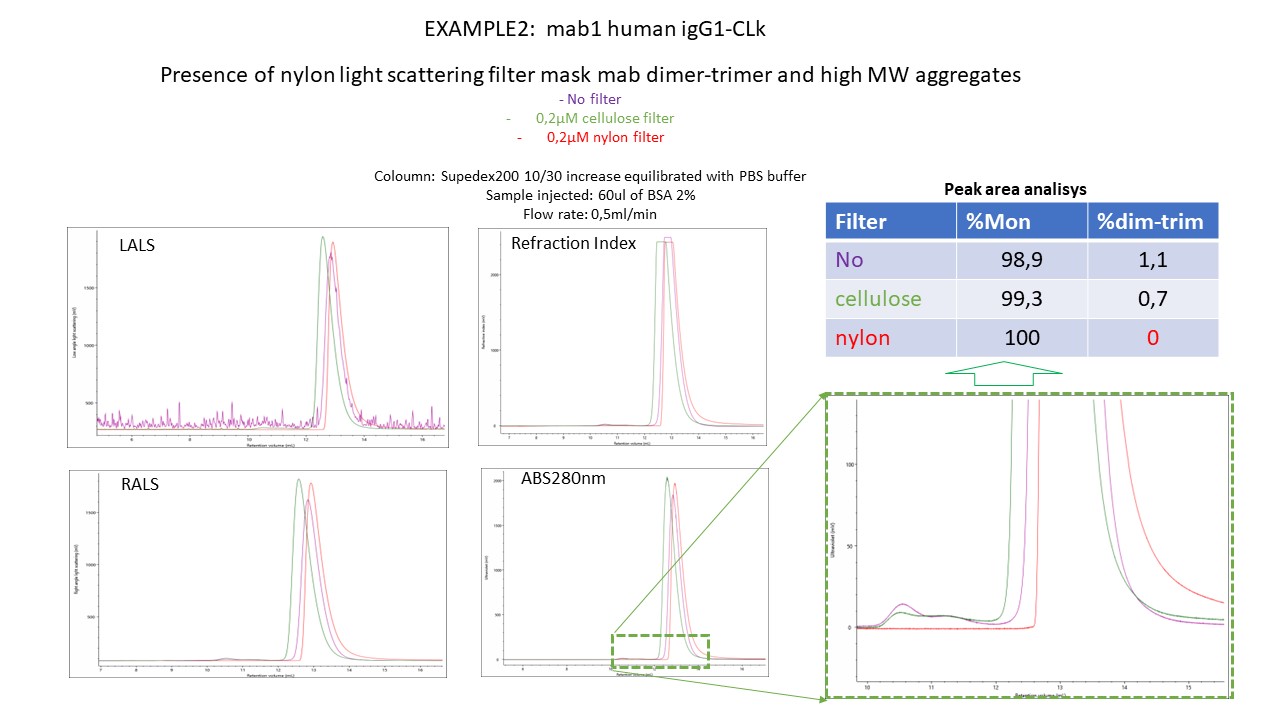
To assess it, a 2% BSA standard and 2 different purified monoclonal antibodies (igG1 human) were loaded in the superdex200 10/30 increase coloumn and analized with the OMNISEC instrumentation  


In all the 3 cases, the Nylon filter guarantee the best signal/noise ratio at LALS but it seems to mask the presence of a significant fraction of high molecular weight proteins.

This was most evident for the mabs, since the dimeric-trimeric and MW aggregates were not detected, even if at UV and RI, using the nylon filter.

ThIs differences may lead to overtimating the quality of a certain mab or protein preparation and it can lead to false positive results in case of stability studies that  would like investigate the mab/protein aggregation propensity under stress (as acid pH, 37°C, freeze/thaw)

For this kind of studies cellulose filter seem to be the best compromise between quality of LALS signal and recovery of the protein polimers. 

As a general comment: Often the diffence is in the details! It is important be able to critically review the Positive results to distinguish the real positives than false positives! 

Suggested links: 

https://www.materials-talks.com/how-to-change-the-light-scattering-post-column-filter-membrane/


Monday, November 7, 2022

ProteoCool Pills#21: Chromas a free tool to check your Sanger sequencing results

In the last 20 years several different software packages able to support the scientist in their molecular cloning activities  (e.g primer desing, sequence assembly, transaltiion, vector desing  desing to manipulate DNA and protein sequences  as CloneManager, SnapGene, VectorNTI (discontinued by Thermo from 2019)

Those software are fully integrated set of tools for e cloning simulation, graphic map drawing, primer design and analysis. They are charaterized by a huge number of functions and they require the payment of a licence. 

Are those advanced softwares striclty necessary for a molecular biologist that would like just to check the result of a gene cloning into a mammalian or bacterial expression vector ?

In my opinion NO! 

Those softwares could be certanilly useful (for example to map the primer annealing region, to desing the vector map) but not essential expecially if you have to produce a limited number of clones in parallel.

For example, in this post i would like to present youm  Chromas, which  is a free simple, easy-to-use sequence viewer and editor (able to open chromatogram files(.ab1) produced from automated Sanger sequencers) that could be used to check your sequencing results.

7A. Allign the Chormas sequence with the “Theoretical” DNA template 
or 
7B. Translate the sequence in AA format 
 (Generally I’m using the Translate Tool available at the Expasy web server) 
and allign the translated sequence with the “theoretical AA” template

If the sequence show some point mutation or shift, do not  discard the clone but check carefully the chromatogram to see if the mutation/shift is real or is it due to a non-correct Chromas assignment that may happen in case of:
-  overlapping peaks:
- peak with low intensity;
- a sequence regions with multiple residues of the same species;
  
Other similar softwares:


Wednesday, April 13, 2022

ProteoCool Pills#15: An alternative way to fix the sticky pad to the Eppendorf S41i CO2 shaker

In the last 20 years, thanks to the adaptation in suspension of several cell lines and to the development of more efficient transfection agents (eg lipofectamines) and culture media, the scientist were able to obtain amazing progresses in the performance of mammalian expression systems, 

As I already reported in the ProteoCool n° 29 and in the tips of the week#8 , modern cell lines, as  ExpiCHO and Expi293, are able to produce high levels (up to 300-500mg/l) of recombinant antigens and/or antibodies in the culture surnatants also in shaking flask culture. 

The availability of an orbital shaker able to maintain 5-8% of CO2 atmosphere is essential during cell propagation and maintenance.

Differently to bacteria, the cell lines do not require high shaking rates (generally 120-125rpm) but are more prone to contamination, therefore since the cleanliness is essential, the use of sticky pads, those can be easily removed and sainted with ethanol or isopropanol solutions is preferable respect than the conventional flask clamps.

To my knowledge Eppendorf S41i (previously New Brunswick) and  the Infors multitron  are the mostly used for mammalian cell cultures.

In this presentation I would like to share with you,  my experience with the Eppendorf S41i

In our lab we have 2 Eppendorf S41i shakers:

- 1st setted at 37°C- 8% CO2 and 120rpm for propagation of both Expi293 and ExpiCHO and for transfection of Expi293 cells;

-  2nd setted at 32°C- 5%CO2 and 120rpm for the transfection of the ExpiCHO cells; 

The first shaker was acquired in 2016-2017 while the second in the 2020. 

Our older S41i shaker carry a platforms characterized by a smooth surface and the sticky pads attach well  directly to its surface


                   while our newest  S41i shaker carry a platforms characterized by a rough surface and the                         sticky pads don’t stick well to its surface.

                   Eppendorf sell a Stickpad ADAPTOR KIT which contains 2 metal smooth plates

                                but this kit seems to be designed for a different shaker format since

               the sizes of those plates are not appropriate to cover the entire area of the shaking platform.


Since the Eppendorf S41i is smallest than other shaking incubator, e.g. the multitron, 
 giving up such a large part of the plate surface represent an important limitation that may 
induce the scientist to choose a different shaker for their laboratories. 

In this post, I would like to show how we were able to cover with the sticky pad the entire shaking platform of both our shakers

           You can use the fixing screws supplied with the conventional flask clamps or wtih the Stickpad ADAPTOR KIT  to drilling and fixing the sticky pads directly on the black  shaker platform.


Standard Washers with 6mm in diamteter

 those can acquired in the most hardware stores /e,g  Leroy Merlin, Obi, Bricoman, Brico ) to ensure the sticky pad integrity and extend the life time of this solution.

N.B I'm happy to share with you that, as responce to this post, Eppendorf specify  that all the platforms actually produced are chatacterized by a smooth surface and the sticky pads are able to attach directly to it. 


Friday, November 26, 2021

ProteoCool Pills#14: Hints for cell propagation and recombinant protein expression using Expi-CHO and Expi293 (WT and GNTI-)

For many years the application of the traditional adherent mammalian cell cultures for recombinant protein production was difficult and applicable only in those approaches requiring very low protein amount (ug’s) because cell scale up was very difficult, transfection not very efficient and the final volumetric yields (mg/litre) very low. 

This limitation forces the scientist to use other simple eukaryotes expression systems as Pichia Pastoris or Baculo virus for the production of mammalian protein in mg scale.

However, in the last 20 years some technological improvements as:

 1) The adaptation of several cell lines to suspension cultures;

 2) The development of more efficient transfection agents;

 3) The development of serum free media where the cells are able to growth at high cell density;

Improve drastically the performances of the mammalian expression systems;

As I already mention in previous presentations, theExpi293 and Expi-CHO date, represent 2 of the most performing mammalian transient expression systems. 

If it is true that those systems are quite expensive, on the other hand they are very simple to use and guarantee, high yields also in shake flask. 

For some recombinant protein, Expi293 in shake flask were able to provide me up 300mg/yields. 

Values that until some years ago were reachable only using E. coli expression in high cell density set-up (e.g. feed-batch fermenters)

Expi-CHO are able to provide up to 100-200 mg/l of full length recombinant antibodies. Full length antibodies are big (150KDa), composed from 2 chains and contains several disulfide bonds, their expression in bacterial expression system is very challenging.

However, to reach those results details, as;

-             - The selection of the optimal shake flask format and right culture volume;

-              -  The selection of an antibiotic not affecting cell growth and protein expression;

-                The selection of the optimal signal peptide for protein secretion into the cell surnatant;

can make a huge difference!!

The selection of the right shake flask and culture volume

Expi293F and Expi293 GNT- cells :

In small scale (up to 60ml culture) Expi293 are not so sensitive to the flask format and presence of baffle:

For example, in our experience Expi293 are growing well in both

-        Erlenmeyer flaskscup vented plain (cost ~ 8€/flask for 125ml format)

-        Erlenmeyer flasks cup vented baffled

-        Thomson Optimun growth flaks  (cost ~ 8€/flask for 125ml format and 30€/flask for 1,6l)

Optimal culture volumes: 

125ml flask volume for 30ml Expi293 transfection and 250ml flask volume for 60ml Expi293 transfection

For culture scale up (eg 200-500ml culture),  the Thomson Optimun growth flaks eems to perform better probably  because it guarantee better CO2 and oxygen exchange.

My preferred format is 200-300ml transfection in 1.6liter flask and generally we do not exceed the 500ml single transfection (using a 2.4 litre flask) because in high volumes we more frequent bacterial contamination was observed, therefore in case of large culture volume e.g. 1-2liter, I prefer to split the culture using more flask in parallel.

ExpiCHO:

ExpiCHO show an high tendency to aggregate and are much more susceptible to  the flask format.

Thomson Optimun growth flaks https://htslabs.com/og/ that contain small baffles seem to represent the best compromise and are the format more able to prevent the cell aggregation during the cell maintenance passages.

N.B: Expi-CHO are able to growth up to very high cell density (>10milion/ml) but to avoid cell aggregation is it better do not exceed the 6 milion/ml during the cell propagation passages

Optimal culture volumes: 

   125ml flask for 25ml transfection 

   250ml flask for 50 ml trasfection

    1,8liter flask for 150-300ml tranfection

In all cases we use the max titer protocol à 8day of trasfection at 32°C

The selection of the right antibiotics to prevent cell contamination.

The Expi293 and ExpiCHO Thermofisher manuals do not suggest the addition of any antibiotics to prevent bacterial contaminations. However after that we experienced some culture contaminations, considering the high  cost of the reagents (more than 1000euro/Liter)  we decided to perform some  transfection trials in the presence of  antibiotics to see if they affect or not the cell viability, growth rate and recombinant protein expression

Expi293 are not affected by:

-        Pen/strep (thermo cod. 15070-063) diluted 1:100 (50 unit/ml penicillin and 50ug/ml Streptomycin)  

-        Gentamicin (Sigma cod. G1272) diluted 1:200 (50ug/ml)

Generally, we use for cell propagation and transfection the Pen/Strep 

Expi293 GNT- are not affected by Gentamicin (Sigma cod. G1272) diluted 1:200 (50ug/ml) while reduction in cell growth rate and viability was observed in presence of Pen/Strep;

Expi-CHO are not affected by Pen/strep (thermo cod. 15070-063) diluted 1:100 while reduction in cell growth rate and viability was observed in presence of Gentamicin diluted 200 times.


Monday, May 17, 2021

ProteoCool Pills#6: Rapid protein Expression and solubility check using a 24 tip-horn sonicator


The use of high cell density media (e.g Enpresso reported in the ProteoCool n°7 or YGR reported in the ProteoCool n°32 ) for protein expression using E.coli allows to scale down culture volumes and easily express many clones in parallel.

Protein expression and solubility check can become a limiting step and the set-up of a simple and reliable protocol is essential.

Automation by using robotic platform is a possible solution for a real high-throughput approach, (e.g a screening projects that require to process  thousands samples for week) but in the most cases just the implementation of a optimized and rational protocol based on the use of multi-channel pipettes and 96-deep well plates can allow to manipulate in parallel up to hundreds samples/week with low cost and high protocol flexibility.

The lysis method used in the small scale test need to be similar to the ones that will be applied for the purification of the protein from rest of biomass in case of positive results, and therefore Sonication or is preferable respect than freeze-thaw cycles (work well in small scale but is not scalable) and chemical/enzymatic lysis ( expensive in scale-up)

Protocool

1) About 8OD of bacterial cells (for Enpresso correspond to 800ul not induced or 500ul induced 8h or 300 ul induced 24h) were transferred from culture into the 96 Deepwell plate following the scheme reported below (to fit the 24 tip sonicator horm)


2) Plate were centrifuged for 20' at 3700 rpm and 4°C


3) After centrifugation the surnatants were discharged 


4)   
The pellets were resuspended adding 960ul of cell Lysis/binding buffer ( eg: Tris 20mM, NaCl 300mM, imidazole 10mM pH=8 for His-tagged protein that will be purified by IMAC) and mixed 3-5 times with the multichannel to allow complete pellet re-suspension. 

2)    Cell Lysis by sonication using the 24-tip horn:

Sonication cicle: 30’’ ON/45’’ OFF , 20 cycles  50% power – Qsonica Q700 sonicator.

The plate need be placed in ICE during the sonication to avoid sample heating.

3)    From each well 60ul of sonicated solution (Total fraction) e transferred in PCR plate no skirted containing 20ul of Loading sample buffer 4X ( eg. Thermo scientific cod. NP0008 ) with reducing agent.

4)    The 96-deepwell plate were centrifuged at 20’ a 4000rpm 4°C;

5)    From each well 60ul of surnatant (Souble fraction) e transferred in PCR plate no skirted containing 20ul of Loading sample buffer 4X ( eg. Thermo scientific cod. NP0008 ) with reducing agent.

6)    The no skirted PCR plate is closed by aluminum foil and incubated 5’ a 95°C in a PCR machine.

7)   12ul of each samples were loaded in a 26well 4-12% SDS-page gel.

Example of results:


Sunday, April 11, 2021

ProteoCool Pills#1; Overload of centrifugal Ultra-filtration device may cause partial sample lost


TIPS of the Week #1
(11/04/2021)

Overload of centrifugal Ultra-filtration device may cause partial sample lost


The centrifugal Ultrafiltration concentrators present in the upper part a small channel
 that allows air to enter and permit sample concentration. 
Sample


Without this channel the sample would quickly go under vacuum and the concentration would stop immediately.  

In case of sample overload, especially using swinging bucket rotors, the sample excess can leak through the channel and some sample can be lost

Conclusion: 

PAY ATTENTION TO NOT OVERFILL THE CONCENTRATION DEVICE


ProteoCool37: Densitometric analisys of SDS-page using Image LAB software (license free version)

  A new video exploring how to optimize the densitometric analysis of SDS-PAGE gels using the basic version of Bio-Rad Image Lab is now avai...