Thursday, June 4, 2026

ProteoCool Pills #33: What about specificity of antibody isotyping kits?


Humans and mice share five primary antibody (immunoglobulin) isotypes: IgM, IgD, IgG, IgA, and IgE. While they share identical foundational functions, they differ notably in structural subclasses, serum concentrations, and specific immunological functions

Human and mouse Immunoglobulin G (IgG) are structurally similar but differ significantly in their subclass classifications, receptor binding affinities, and functional profiles.

In both cases IgG is the prevalent subclass which accounts for approximately 70% of circulating antibodies but the distribution and functionality of subclasses (e.g. IgG1vs IgG2)) change a lot, which directly influences how preclinical research translates into human. 

For example; while in human the IgG1 is the common subclass, highly effective at neutralizing viruses and toxins, triggering complement activation, and driving antibody-dependent cellular cytotoxicity (ADCC) and the igG4 does not activate the complement system and has limited effector functions. On the contrary in mouse the IgG1 has show functionality similar to human igG4 and the igG2a/igG2c is primary drivers of ADCC and complement activation, acting as the mouse equivalent to human IgG1. 

Antibody isotyping is the process of determining the specific class (e.g., IgG, IgM, IgA, IgE, IgD) and subclass (e.g., IgG1, IgG2a, IgG2b, IgG3) of a monoclonal or polyclonal antibody based on its heavy and light chain structures. 

Antinody isotyping is from long time a critical in-process validation step in the antibodyt generation required to:

- Select optimal hybridoma clones;
- Select the more appropriate downstream purification strategies;
- Choose the appropriate secondary reagents for immunoassays

More recently antibody isotyping become also a critical analitical step in Chinese Hamster Ovary (CHO) cell production iused to confirm that the recombinant antibody being produced has the correct heavy chain class (e.g., IgG1, IgG4) and light chain type (kappa or lambda ). 
While often associated with characterizing hybridomas, in CHO production, a recombinant proces, isotyping is used to verify the construct design, check for proper assembly, and ensure isotype stability in stable cell line. However confirming the correct isotype (e.g., IgG1, IgG2, IgG4) is required as part of the initial structural characterization and identity testing during the drug approval process but it is not required for the routine, batch-by-batch analysis for lot release.

Several antibody isotyping kits, typically using lateral flow or ELISA, those are suggested toutilize well-characterized antibodies with negligible cross-reactivity, designed to detect specific heavy and light chain.

Recently I add the opportunity to perform some analisys using Pro-Detect human and Pro-Detect mouse kits (based on lateral flow approach) and i took the opportunity to verify their specifity by checking whether how the kits are able to distunguish a single antibody subjected to isotype switching from mouse IgG1 to human IgG1 and IgG4.

The protocola for both mouse and human kits are really simple, you need just to dilute the antibody to the suggested concentration range, transfer 150-200ul of diluted antibodies to the bottom of an 2mL eppendorf tube and insert the strip on the tube. Each kit proved to strips, a blue strip for the light chain typing and a red strips for the heavy chain typing. Wait 5-10 minutes for colored bands to appear and immediately evaluate the results.

How you can see in the following pictures: 


Mouse isotyping kit show good specificity since it was able to identify the antibody produced in the mouse IgG1 form but not the same antibody in the Human IgG1 or Human IgG4.


Human isotyping kit show good specificity since it was able to identify the antibody produced in the Human IgG1 or Human IgG4 forn and not the one produced in the Mouse IgG1. 

At this point I was curious to check if the Human Antibody isotyping kit may be affected by ADCC-modulating mutations that were previouly discussed in the ProteoCool Pills#31  and i tested the ability of the Pro-Detect Human kit to recognize the same clone carrying the LALA, LALAPG, LALANA mutation described to reduce or fully abrogate Fcγ binding affinity and downstream effector cell activation.


The kit perform very well with all the mutations tested. Tested mutations do not affect the ability of the kit to bind to the human IgG1 Fc.


Wednesday, September 10, 2025

ProteoCool Pills #32: HemA, a powerfull selection marker for antibiotic free plasmid mantainance for recombinant protein expression in E.coli


Antibiotic resistance genes  (e.g Ampicillin, Kanamycin) are the most commonly used markers for plamisd selection in DNA production and recombinant protein expression processes. 

Adding an antibiotic resistance gene to the plasmid solves 2 problems at once:  It allows a scientist to easily select the plasmid-containing bacteria when the cells are grown on selective media and at the same time provides those bacteria with a pressure to keep your plasmid.

For the reason the most of commercial vectors suitable for recombinant protein expression in E.coli  as pET,  pQE, pMal, pCold, pGEx carry Ampicillin, Kanamicin selection marker. . 

Even if this strategy work very well in R&D setting, on the contrary it has several drawbacks for biological manufacturing. 

The spreading of antibiotics in the environment and consequent emergence of multi-resistant pathogenic bacterial strains has become a general promise to even further increasome categories of biological products such as DNA vaccines where potential issue of allergic reesponses to some classes of antibiotics is evoked and the necessity to document the trace amount of antibiotics. 

Apart from the use of the antibiotic itself, there is another emerging limitation in the use the antibiotic resistance gene used as a selection marker due to the potential risk of horizontal transfer of antibiotic resistance gene to environmental microbes

Behind the regulatory issues, the use of antibiotic resistance gene marker imposes a significant metabolic burden on the cells and may. also impact the process yield. 

At least but not last,antibiotics themselves are expemsive and therefore often omitted in fermentations, leading to plasmid loss and a corresponding loss in product yield. 

In this context novel strategies to efficiently replace antibiotic-based selection are required. 

To date, several systems have been developed based on different principles, each presenting advantages and drawbacks. 

The most common way to achieve selection in the absence of antibiotics is the complementation of an essential gene making use of an expression vector in a strain with a defect or inhibited expression of the same essential gene.

Several examples are reported in literature where the plasmid selection is achieved through the complementation of amino acid auxotrophy (e,g Proline;  Glycine)  and more recently of QAPRTase, an enzyme implied in de novo nicotinamide adenine dinucleotide biosynthesis. 

Many different E.coli auxothopic strains were already generated but to ensure the proper selective pressure, the auxotrophy complementation systems reported so far require the use of chemically defined media since the standard complex media contain variable amounts of aminoacids as well as other catabolites that covercome the need of biosynthetic pathway and as a consequence the loss of selective pressure for the complementation plasmid maintenance.

About 10 years ago I was involved in a project aimed to developed a novel antibiotic free plasmid selection approach for protein selection in E.coli. 

Some experiences gained in previous work activities such as: 

1) The positive effect that the supplementation  δ-ALA (δ-aminolevulinic acid) has on recombinant Human cyt c expression in E.coli (CERM)

2) The use of 5-aminolevulinic acid (ALA) as  a prodrug to stimulate  intracellular Heme biosynthesis to produce the natural photosensitizer (PS) Protoporphyrin IX (PpIX) in antimicrobial photodinamic therapy (Molteni Therapeutics)

lead me tot think that the complementation of hemA deficient bacteria by a vector carrying a functional hemA gene, as a selection marker, which confers to the transformed bacteria the ability to grow and maintain the vector in any medium that does not support growth of hemA deficient bacteria of a mutation in heme biosynthetic pathway and at the same time the complementation of empty cells with 5-ALA allow to easly propagate and prepare the empty competent cells.

After several months of work we produced an interesting data package supporting our hipotesis and a patent application was filled and submitted (WO2015165841 - AN ANTIBIOTIC-FREE METHOD FOR SELECTWO2015165841 - AN ANTIBIOTIC-FREE METHOD FOR SELECTION OF TRANSFORMED BACTERIA)

Even if the patent was not accepted since the examing authority do not recognize its inventive steps since the HemA was already show to work as selectable marker in Aspergillus Oryzae, i still think that it is work very well in E.coli since we was able to show that the Delta HemA E.coli  show negligible growth in both chemical defined and complex media but the growth it readly restored when there are complemented with 5-ala or plasmid carryng (see Fig2a,2b and Fig3a,3b of the WO2015165841 patent application)   the HemA gene and that the expression was mantained after a several different passages.

E. coli BL21(DE3) DeltaHemA/pet21-BFP and E. coli BL21(DE3)/pet21-BFP were cultivated without antibiotic selection for many generations by diluting a 12h culture 1:100 in fresh medium for several times. After 1,2,5,10,15 passages the recombinant protein expression was analyzed (1G ≈ 7-8 duplications) and as reported in the Fig5 of the WO2015165841 patent apprication,  the BFP production in HemA mutant strain complemented with BFPpet24-HemA is stable after 15 cultivation cycles without antibiotic while in the wild type strain transformed with standard BFPpet24, it dramatically decreases after 5 cultivation cycles without selection.     


 I would like to Thanks to

Maria Giuliani

that performed the most of the experimental work

and provide an essential contribute in experiment desing 


Thursday, June 12, 2025

ProteoCool Pills #31: Modern Approaches to modulate the antibody effector function


Full length human IgG antibodies are composed of 2 regions, the N-terminal region of each chain corresponding to the Fab (fragment for antigen binding which contain the variable regions and the CDRs) and the C-terminal region corresponding to the Fc (crystallizable fragment)

Until some years ago the scientist focus mainly their efforts in the optimization of the Fab regions to develop antibodies with highest antigen affinity and lower immunogenicity.

In the last years, especially with the emergence of bispecific antibodies, e.g T-cell engagers there has been a growing interest in modifying the Fc region to modulate (enhance or remove) the antibody effector function.

The Fc region is able to bind with high affinity the Fc gamma receptors (FcγRs), and the neonatal Fc receptor (FcRn) expressed in the surface of the immune system cells (Reference)  by triggering  different effector functions such as antibody-dependent cell-mediated cytotoxicity (ADCC) and antibody-dependent cellular phagocytosis (ADCP) and complement- dependent cytotoxicity  (CDC) responses (Reference)

Among the four subclasses of human IgG (IgG1, IgG2, IgG3, IgG4), which differ in their constant regions, particularly in their hinges and CH2 domains, IgG1 has the highest FcγR-binding affinity, followed by IgG3, IgG2, and IgG4. As a result, different subclasses modulate in different way the different responses ADCC, ADCP and CDC.  (Reference)

In in the first generation of monoclonal antibodies the Fc activity was modulated by producing of the antibody in different Fc format on the basis of the antigen properties and the MoA (mechanism of action) that they would confer to the antibody: 

Blocking antibodies that do not have to activate the immune response where produced in the IgG4 format

For example Nivolumab which binds to the PD-1 receptor located on the cell membrane and inhibits its interaction with its ligands, PD-L1 and PD-L2. Since PD-1 is expressed on activated T cells, NK cells, regulatory T cells and B cells. Nivolumab has been desinged to block the interaction with the PD-L1 and PD-L2 and therefore releases immune cells from pathological immune suppression, but not activate the immune-response against these immune-cells otherwise we will obtain the unwanted depletion of effector cells inducing  serious adverse events..

On the contrary, mabs targeting antigen expressed in the surface of cancer cells (e.g Cetuximab targeting EGFR) were produced in igG1 form to activate the immune-response against those cells and induce cell clearance. In fact, it has been demonstrated in preclinical models and ex vivo studies that target-bound cetuximab IgG1 isotype mAbs stimulate natural killer (NK) cell–driven cytotoxicity against tumor cells coated in mAbs via the interaction of the constant region and the CD16 receptor on NK cells

More recently  igG1-Fc sequence engineering were largely exploited to further improve the modulation of Fc function:engineering as well as CHO cell line 

Fc Function enhancement:

It is well-known that this effector function is modulated by the N-linked glycosylation in the Fc region of the antibody (N297 of IgG1).


 In particular, absence of core fucose on the Fc N-glycan has been shown to increase IgG1 Fc binding affinity to the FcγRIIIa present on immune effector cells such as natural killer cells and lead to enhanced ADCC activity.

As I reported in the ProteoCool Pills #10, the simple supplementation of the culture media with  2F-Peracetyl-Fucose allow to produce low fucosilated monoclonal antibodies in mg scale to be used for R&D screening, on the other hand, several strategies (as the GlymaxX® and POTELLIGENT®  have been developed to build stable clones for large scale production based of afucosylated antibodies with improved therapeutic potency.

Since those cell lines may show some drawbacks in terms of growth rate and mab productivity at the same time other scientists focus also in the development of igG1 mutant (eg S239D/1332E  named SDIE and G236A/S239D/A330L/I332E named GASDALIE – US patentUS20230057150A1  those similarly to afucosilated mab show improved affinity for the FcγRs even in produced in the standard CHO cell lines.

In the past I had the opportunity to do some trials comparing the ADCC activity (using the Promega ADCC assay, both F and V versions) with using the igG1 WT afucosilated and igG1 SDIE mutant (produced with standard fucosilation) for the same clone and interestingly  (data not shown) it seems that their effect could be combined at least from the results of this in vitro assay. 

B) Fc Function silencing:

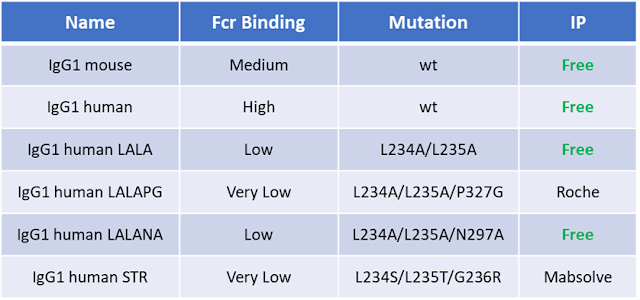
The most recent alternative to the use of IgG1, which allow to point mutations in the linker region between hinge and Fc domains were described to reduce or fully abrogate Fcγ binding affinity and downstream effector cell activation

In the following Table are reported some of the most known and used mutations:


From literature the STR (recently developed by MAbSolve seems to be the only mutation that completely abolish all the ADCC, ADCP and CDC activities (Reference) and  it seems that STR do not alter the antibody developability profile.

Even in this case I had the opportunity to do some R&D trials comparing the igG1 human wild type, LALAPG and STR mutants and I was not able to was not able to reveal meaningful differences between LALAPG and STR with the Promega ADCC assay (complete abolishment in both cases – data not shown) but this can be due to the fact that as shown in seems that the advantage of STR vs LALAPG is in the lower affinity of STR for the FcγRI which is probably more involved in trigger the ADCP than ADCC response or that the sensitivity of those kind of assay is not enough to detect so small differences (see Table3 the authors do not reveal any differences even in ACDP assays

I also performed antibody aggregation propensity detected performing SEC on 10mg/ml samples subjected to different incubations (4°C, 37°C, Freeze/Thaw) and in this case the LALAPG seems to be slightly better (data not show)

However, this post does not would provide any ranking or evaluation of the different mutants but just inform you about the possibility to test them to achieve the wanted MoA for your new monoclonal antibody.


Thursday, February 27, 2025

ProteoCool Pills #30:How improve Specific heavy-light chain pairing in the production of bispecific mabs


A Bispecific antibodies (BsAb) is a single molecule that comprise two single binding entities that are physically connected, which enables simultaneous binding to two different epitopes  on two different antigens or even in some cases two different epitopes on the same antigens (named biparatopic antibodies). 

The ability of BsAbs to bind to different antigens was largelly exploited in immunotherapy to act as a linker beetween  a cytotoxic cell and a target (a tumour cell) to be killed. 

For example T-cell-redirecting bispecific antibodies  (named T-cell engagers) are specifically designed to bind to tumor-associated antigens, thereby engaging with CD3 on the T cell receptor. This linkage between tumor cells and T cells actively triggers T cell activation and initiates targeted killing of the identified tumor cells. These antibodies have emerged as one of the most promising avenues within tumor immunotherapy.

The main issue associated with asymmetric BsAbs is mispairing of polypeptide chains leading to product-related impurities. In fact BsAbs assemble require co-expression of 4 different chains (2 different heavy chains and 2 different light chains),  each heavy chain can form either homo- or heterodimers, which in turn can associate with the two light chains. From a stochastic view point, this leads to 16 chain arrangements with 10 unique combinations, including only one, that represent only the 10% of the total mixture, that is the desidered BsAb where heavy chain exhibit the correct heterodimer and pairing with distinct light chains and this low probability impairs the manufacturability of bsAbs 


Protein engineering was largelly applied in the last 20 years to solve this issue.

First of all, complementary mutations that favors heavy chain (HC) heterodimerization while disfavouring formation of HC homodimers were reported. The first reported, and most widely used, platform is the knob-into-hole (KiH) which introduces a large bulky tryptophan in one HC and smaller sterically complementary residues in the other HC. The KiH strategy is widely implemented because it is highly effective in suppressing the most of HC homodimers and because its patent has expired 

While the correct heavy chain heterodimerization can be enabled using the knobs-into-holes (KiH) approach, the correct association of generic light chains has remained a problem, in fact even in presence of KiH there are still 4 possible random combinations that limit the fraction of desidered form only to about 25%

To solve this issue the KiH could be coupled with the CrossMAb technology that was described and patented by Roche in 2011 (it is stil protected by IP). which is able to enforce correct light chain association in bispecific heterodimeric IgG antibodies. 

This technology could be applied to any existing antibody pair using domain crossover, without the need for the identification of common light chains, post-translational processing/in vitro chemical assembly or the introduction of a set of mutations enforcing correct light chain association.


In the past I had the opportunity to produce for R&D purpose 2 different bispecific containing both KiH and Crossmab and in both cases the antibodies were produced fron CHO with high yields (transient trasfection) and the an very good rate of HC-LC correct coupling (>90%)    was detected in both cases by mass-spectrometry.


Sunday, August 4, 2024

usefull links #1

i would like with share the folliwng 3 links about usefull on line tool for the scientist working with recombinant monoclonal antibodies: 

 1) ABRSA is a simple and useful tool for antibody numberimg and cdr identification 

 2) PLABDAB is a repository containing over 150,000 paired antibody sequences derived from patents and academic paper. it is vero usefull to underand if a mab sequence is patented or not. 

 3) TAP is an on line tool to idenify criticism that cam affect mab developabilit

 #mab #onlinetools #science #cdr #antibodynumbering

Sunday, October 29, 2023

ProteoCool #Pills29: Simple solutions to improve laboratory routine work with few euro/dollars: #1 IKEA


Chain stores with furniture, DIY, decoupage hobbies as 

IKEA, OBI, Leroy Merlin, Bricoman 

 can be a great source for funny and cheap items useful for improve the laboratory organization

Here i report just some examples: 

1) SANDVIVIA OVEN MIT 

                   made in silicone which provides a firm grip and is heat-insulating.

It allow to manipulate and move the hot agarose gel and/or hot culture media removed from microwaves or autoclave.

                                           Avaialble from IKEA (Italy: 3euro - US: 4 dollars )

-----------------------------------------------------------------------------------------------------------------------------

2) VEKSEN CART 

It fits in the smallest of laboratory, but there’s plenty of space on the shelves for all  for all those staff that you need to have on hand when you work on the laminar hood

             or in a laboratory with low space 


Assemble the trolley quickly and easily by clicking the parts together without any specific tools.

Available from IKEA (Italy: 10 euroUS: 9 dollars

----------------------------------------------------------------------------------------------------------------------------

TIKSEN Hook with suction cup.

Alternative clothes hanger solution

Available from IKEA (Italy: 7euro/4p; US: 5dollars/2p

......................................................................................................................................................................

                                                                    BEVARA Sealing clip. 

                                                       Cheap clips for use with Dialysis Tubing 

                                         Available from IKEA (Italy 1,5euro/10p: US: 2 dollars/10p 


Friday, August 25, 2023

ProteoCool Pills#28: Extracellular vesicle production using ExpiCHO

 In the last 10 years the genetic engineering of bacteria as well as mammalian cell lines allow to design and produce extracellular vesicles decorated with specific protein antigens that can be used as vaccine Outer membrane vesicles (OMVs) are released spontaneously during growth by many Gram-negative bacteria. candidates, as immnunogen for the production of monoclonal antibodies for those antigens (eg intregral membrane proteins) that are difficult to produce in soluble recombinant forms.

Extracellular vesicles are released spontaneously during growth of Gram-negative bacteria as well as mammalian cell lines (eg. HEK293).

For some applications wild-type strains can be used directly to produce an extracellular vesicle but, in most cases, genetic engineering of the expression Host is required not only to induce the over-expression of specific single on multiple antigens but also to improve vesicles productivity and safety.

In gram-negative bacteria several genetic modifications able to improve vesicles production (eg.  TolR, OmpA deleted strain) as well as modifying the synthesis of a LPS carrying (e.g msbB, pagP and other mutants) and reduce vesicle reactogenicity were already identified and tested.

Therefore, even if the mammalian extracellular vesicles (e.g exosomes) have been more extensively studied than bacterial extracellular vesicles, one of the challenges the limit the use of mammalian vesicles as scaffold for antigen expression is their low production yield.

Therefore, similarly to what happened 20 years ago at the beginning of recombinant protein expression age, the Bacteria thanks to their rapid proliferative abilities, process scalability of their culture methods and gene editing ability has been more extensively applied for extracellular vesicle production.

However, in the last 20 years several new technological improvements as:

 1) The adaptation of several cell lines to suspension cultures;
 2) The development of more efficient transfection agents and new gene editing technologies:
 3) The development of serum free media where the cells are able to growth at high cell density;
 
Improve drastically the performances of the mammalian expression systems and make it not only very interesting as platform for production of recombinant soluble proteins but also as factory of engineered extracellular vesicles.

Chinese hamster ovary (CHO) cells are widely used host cells for recombinant protein production and currently the most commonly utilized mammalian organism in large scale bio-pharmaceutical production and some recent papers (1,2) report their ability to produce extracellular vesicles.

As I already show you in the ProteoCool Pill#8  the ExpiCHO cell line is a CHO derivate that thanks to its ability to growth very high cell density (8-10 milion cells/ml) and high transfection efficiency result in high yields of recombinant antibody and protein production.

In this post I would like to briefly share with you some preliminary result that suggest as ExpiCHO may become also a promising platform for production of engineered extracellular vesicles. I would like to point out as the fact that ExpiCHO growth very well in serum free media is essential for production of engineered extracellular vesicles since the serum contain a large amout of  unwanted empty vesiscles that may contaminate our preparation and vesicle serum depletion is time consuming and difficult to scale up. 

This trials were performed by comparing the extracellular production ability of commercial ExpiCHO empty cells with an antigen over expressing Expo-CHO cell line derivate that was generated  (data not shown) using the Flp-In cloning system. 

Since Expi-CHO Flp-In cell line are not commercially available, first of all, an ExpiCHO Flp-In cell line was generated by transfection of ExpiCHO with pFRT/lacZeo vector and the positive clone were  isolated after growth under Zeocin selection. 

Afterwards the GPCR expressing ExpiCHO cell line was generated by co-tranfection of GPCR-pcdna5/FRT and pOG44 vectors and the positive clone were isolated after growth under Hygromicyn selection.  
 
                                                     1° Vesicles production trial:   
                Comparison of 2 different growing protocols for the the empty ExpiCHO cell line.
                           
                                                             Protocol Overview

After re-suspension with PBS the Vesicles were subjected to  SDS-page and Nanotracking particle analisys (Nanosight- Malvern)

Even if the NTA results do reveal important differences between the vesicles produced at 37°C and 32°C, the presence of the strong yellow colour (which suggest the presence of some contaminant) as well us the partial resuspension at 32°C lead us to prefer the condition n°1.

                                                          2° Vesicles production trial:   
                Vesicle production with condition 1 using empty and GPCR expression ExpiCHO
                           
Even it those results are really preliminary, the fact that extracellular vesicle expressing a GPCR could be successfully isolated in good amount (about 10^10 vesicles/liter) suggest that ExpiCHO may represent a promising platform for production of engineered extracellular vesicle suitable as vaccine component or immunogen for the production of new monoclonal antibodies targeting specific transmembrane antigens. 


Monday, June 5, 2023

ProteoCool Pills#27: DSF an useful tool for Monoclonal antibodies selection, optimization and developabiltiy assesment


DSF 

(Differential scanning fluorimetry previously named also Thermofluor)

is a very simple tecniques that exploit the ability of a fluorescente probe,  typically either SYPRO Orange or 1-anilino-8-naphthalenesulfonate (ANS) – that is quenched in an aqueous environment but becomes strongly fluorescent when bound to exposed hydrophobic groups of a protein. Therefore, the thermal unfolding of a protein of interest in the presence of such a dye, can be followed spectrophotometrically.

DSF is a 96 well based assay that could be performed on a RT-PCR thermocycler, it is inexpensive,  fast, and require relatively little sample. All these advantages have made this approach attractive for screening applications in drug discovery  and also for protein stability formulation

In the ProteoCool n°24 in suggest as in my opinion the DSF may become an essential assay todetermine lot to lot concistenciy in QC department of company producing recombinant proteins (e.g recombinant vaccine and/or enzymes)

In this post i would like to share with you 2 examples that show as DSF may play an important role also in antibody screening, optimization and developability assesment. 

DSF thanks to its excellent throughput and minimal material consumption (about 50ul of antibody at 0,3 mg/ml for each point) allow to readily compare the thermal stability of:

- different antibodies in the same buffer:

-  different  Fab mutants or Fc mutants in the same buffer;

-  different  antibody formulations; (optimize pH, salt concentration, excipients)


Example 1: 

Comparision of thermal stability of different mabs 

Full length human IgG1-Clk mabs  in PBS may show 1 or 2 separate transitions on the basis of the Fab stability. 

Mabs with lower Fab stability show in general a single transition while mabs with high stability show 2 separate transitions, 1 at about 69°C for the Fc and 1 at higher temperature for the Fab.


Example 2:

Comparision of thermal stability of different Fc mutants

In recent years the enhancement or elimination of the Fc-effector function has led to a growing interest in Fc-engineering, to give antibodies specific mechanisms of action and therapeutic properties.  

Even if several Fc modification, as:

-   LALANA, LALAPG, LALAGR mutations to remove effector function;

SDIE, GAALIE mutations as well as afucosilation to enanche the effector function

 were already reported, few data about developability of those solutions are still available and there is a lot work  to do to select an enanched Fc combining the best effector function and good manufacturability, stability and pharmacokinetics.

Those are just 2 examples that show as in short time and using a limited amount od samples, thanks to DSF we can obtain  essential informations to guide our decision in antibody during the screening, desing, formulation phases.

Of course, thermal stability itself do not Guarantee that the selected antibody has good developability profile but  some of the following other tecniques as:

- DLS;

- PEG solubility;

- Self-interaction determined by BLI;

those provide informations about antibody  aggregation propensity 

- Hydrofobic interaction chromatografy (HIC)

those provide informations about antibody hydrofobicity

have to be peformed to complement the DSF data. 


A great thanks  to

 Luca Sorrentino


Wednesday, May 3, 2023

ProteoCool Pills#26: Guidelines to download a Video from blogger sites

 In the Video Section of ProteoCool are actually available more than 30 different video tutorials about molecular biology, protein expression and characterization. 

All those video can be easily downloaded using the Video DownloadHelper tool available on Mozilla Firefox browser.  No cost or restriction are associated to the ProteoCool video use or sharing. 

I just ask you to cite, ProteoCool, in case you will share or use part of it for build new material. 

In this post I would like to show you, how video download from a Blog (not only PRoteoCool but all the blogger.com blogs is possible using the Mozilla browser

How yu can do it: 

- Open Mozilla Firefox browser; 

- Check if the Video DownloadHelper is already installed in your browser

The presence of the Video DownloadHelper is identified by the presence of an Icon that shows 3 balloons (in gray scale) located on the Firefox toolbar.  

If Video DownloadHelper is already installed, you can choose your video and download it in few minutes following few steps: 

1. Access to the blog from which you would like to download the video (e.g. PRoteoCool)


In case that the Video DownloadHelper is not present in your browser, you can download it:


-                 Click on the VideoDownload helper icon and proceed with the installation by

               following the different instructions.


-              Once the 3 balloon icon will appear on the top of your browser, Downloading videos 

                from the Blogger site is now possible.  

                Go to the step 1  

ProteoCool Pills #33: What about specificity of antibody isotyping kits?

  Humans and mice share five primary antibody (immunoglobulin) isotypes: IgM, IgD, IgG, IgA, and IgE. While they share identical foundationa...